

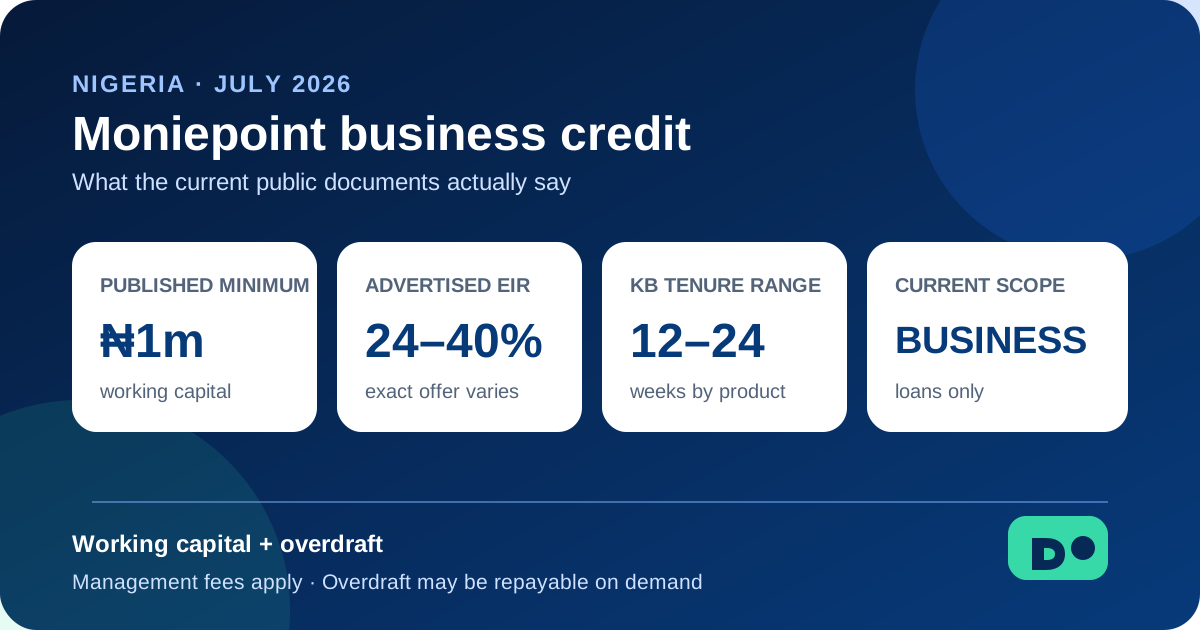
BP25-33-U3-NGAs of 27 July 2026, the Moniepoint loan product that can be verified publicly in Nigeria is business credit from Moniepoint Microfinance Bank Limited, not a general personal-loan app. Moniepoint’s current knowledge base says it offers business loans only, specifically working capital and overdrafts. Its working-capital page advertises a minimum of ₦1,000,000, no physical collateral and an effective annual rate of 24%–40%, while the final limit, rate and repayment schedule depend on the business and the actual offer.
Regulatory cross-check — 27 July 2026
A current product page is not the same thing as a complete regulatory record. Moniepoint’s live legal disclosures say that Moniepoint Microfinance Bank Limited is authorised and regulated by the Central Bank of Nigeria, and its business-loan pages were active during this review. A direct check of the CBN public GetMFBs directory endpoint returned 829 microfinance-bank records but no name match for “Moniepoint” or “TeamApt.” That mismatch is a disclosure gap, not proof of an unlicensed operation: the public endpoint may lag or use another registered name. It does mean the directory should not be cited as direct confirmation of Moniepoint’s licence tier, date or capital level.
| Record checked | What it supports | What it does not support |
|---|---|---|
| Moniepoint legal pages | Entity name and its own CBN-authorisation statement | Independent confirmation of licence tier |
| CBN public MFB API | 829 returned records on the check date | No direct Moniepoint or TeamApt match |
| FCCPC DML register | Status of lenders within the DEON registration scope | Legality test for a CBN-licensed bank |
The FCCPC distinction is explicit. Its 2025 DEON Regulations exclude banks and financial institutions licensed under BOFIA 2020, while the guidelines exclude financial institutions regulated by the CBN. The 20 July 2026 court judgment restored enforcement for lenders covered by DEON; it did not remove those exclusions. For a Moniepoint facility, the operational check is the legal lender written on the offer and contract, not whether the brand appears in an app-lender list.
What Moniepoint actually offers in 2026
The clearest current evidence comes from Moniepoint’s loan knowledge base, refreshed in February 2026. It identifies two business-credit categories: working capital and overdrafts. The dedicated working-capital page is live, but there is no equivalent public page with a complete overdraft tariff or a standalone consumer-loan contract. A merchant credit line, a term-style working-capital facility and a personal cash loan create different repayment risks.
| Question | Verified public position | What remains individual |
|---|---|---|
| Legal lender | Moniepoint Microfinance Bank Limited | The offer letter must use the same legal entity |
| Available loan types | Business working capital and business overdraft | Other future products are not current offers |
| Working-capital amount | Published minimum: ₦1,000,000 | Maximum depends on business type and creditworthiness |
| Working-capital price | Landing page advertises 24%–40% effective annual interest | Knowledge base says rates vary; management-fee amount is not public |
| Loan period | Knowledge-base range: 12–24 weeks, depending on product | Overdrafts are repayable on demand unless agreed otherwise in writing |
| Repayment | Automatic account deduction or manual payment; daily or weekly schedules | Exact dates and instalments come from the individual repayment plan |
| Personal or salary loan | No public current product terms | A single salary-advance mention is not enough to verify availability |
Consumers searching for cash for personal expenses should not treat Moniepoint’s merchant page as an alternative route. The products and regulatory checks in a broader Nigeria loan-app comparison answer a different question from working capital tied to business-account activity.
The 24%–40% figure is not a complete price
Moniepoint’s working-capital landing page uses the phrase “effective interest rates of 24–40% per annum.” That is a useful published band, but the bank’s own knowledge base also says that working-capital and overdraft rates vary. It separately confirms that management fees exist without publishing their amount. A borrower therefore cannot calculate the total naira cost from the headline rate alone.
The decisive document is the individual schedule. For Moniepoint specifically, it should make six items unambiguous: principal, effective annual rate, management fee, total amount repayable, daily or weekly instalment amount, and the consequence of a missed deduction. If one of those fields is absent, a claim such as “24% per year” is not enough to compare the facility with another lender. The top of the advertised band is 16 percentage points above the bottom, so two approved businesses can face materially different costs even before the fee is added.
The public page also promotes processing within 24–72 hours. That describes the bank’s stated processing window, not a guarantee of approval or funding. The amount and maximum limit are personalised; the knowledge base says they depend on business type and creditworthiness. The dollar-denominated ceiling on Moniepoint’s global credit page is not Nigeria-specific and conflicts with the Nigeria product’s personalised-limit wording.
Eligibility is based on business use, not merely owning a POS
The current eligibility article names two concrete conditions: the business account must have been active for at least six weeks, and the owner must use it consistently for business transactions. It does not publish a minimum turnover, a guaranteed score or a formula that converts POS volume into a loan limit. Six weeks is therefore a minimum account-history condition, not a promise that an offer will appear on day 43.
“No collateral” also does not mean “no underwriting.” Moniepoint says the maximum depends on the type of business and creditworthiness. Its knowledge base notes that a CAC document or shop-rent receipt may be requested if business verification fails, but it does not publish a universal document checklist for every approved borrower. Anyone comparing this product with other collateral-free credit options in Nigeria should compare the data and recovery rights being exchanged for the absence of physical security.
Repayment behaviour is part of that risk picture. The bank publishes daily and weekly repayment frequencies and permits early repayment. It also says repayments can be deducted automatically from the Moniepoint business account. A weekly sales cycle paired with daily deductions can create a cash-flow mismatch even when the annual rate looks manageable; the payment frequency has to follow the business’s real collection pattern.
Working capital and overdraft are not the same debt
A working-capital loan provides a defined principal and repayment plan. Moniepoint’s public material places its loan products in a 12–24-week range, with the exact period determined by the product and offer. The working-capital page publishes the ₦1,000,000 minimum and markets the facility as collateral-free, but it does not publish a universal maximum or one fixed rate for every merchant.
An overdraft is more open-ended operationally but stricter legally. Moniepoint’s knowledge base confirms that overdrafts are a current business product and says their rates vary. The bank’s terms add the controlling caveat: unless different terms are agreed in writing, an overdraft is repayable on demand. A borrower should not assume that the general 12–24-week range gives an overdraft a guaranteed term.
A Moniepoint overdraft should not be compared casually with a personal bank overdraft such as the product discussed in our Kuda overdraft guide. The intended customer, account data, repayment trigger and contractual maturity may differ even when both products use the word “overdraft.”
Does Moniepoint give personal loans or salary advances?
No publicly documented personal loan was available in this check. Moniepoint’s current loan knowledge base says, “We currently offer business loans only.” Its personal-account page does contain the phrase “request a salary advance,” and the site navigation uses the broad label “business and individual loans,” but neither location supplies a current lender disclosure, amount, price, tenure or eligibility rule for a salary-advance product.
Those fragments are not enough to tell a reader that consumer credit is available. Until Moniepoint publishes a dedicated offer with terms, salary advance should be treated as unverified rather than as a product a customer can rely on. People who need personal borrowing can compare separately documented products through our loan-app overview; merchant transaction history should never be presented as a back door into consumer credit.
CBN status and why the FCCPC list is a different test
Moniepoint’s current legal disclosures identify the lender as Moniepoint Microfinance Bank Limited and state that it is authorised and regulated by the Central Bank of Nigeria. The business-loan page and the bank’s support material were live on 27 July 2026. A licence tier, licensing date and ₦5 billion capital figure were not confirmed in the primary CBN directory used for this check and are not stated here.
The FCCPC digital-lender register answers a different question. The 2025 Digital, Electronic, Online or Non-Traditional Consumer Lending Regulations exclude a bank or financial institution licensed under the Banks and Other Financial Institutions Act 2020, and the related guidelines exclude financial institutions regulated by the CBN. Moniepoint’s absence from the FCCPC list is therefore not, by itself, evidence that its bank-issued business credit is illegal.
On 20 July 2026, the FCCPC announced that a Federal High Court judgment had removed the interim restraint on the 2025 DEON rules and that implementation resumed. That development matters when checking non-bank digital lenders, including those in our guide to legitimate loan apps and FCCPC red flags. It does not erase the express CBN-institution exclusion or turn the FCCPC app list into a substitute for identifying the legal bank on a Moniepoint offer.
What the default clauses allow
Moniepoint’s short knowledge-base answer says a missed payment may hurt the borrower’s credit rating. The full terms go further. They allow the bank to report a delinquent credit facility to the CBN through the Credit Risk Management System and to request a regulatory set-off against money or financial assets held for the borrower at other Nigerian financial institutions. The terms also allow balances in Moniepoint accounts to be combined or transferred toward the debt.
That is stronger than a reminder notification. It means a default can move beyond the original business account and affect future formal credit. The contract also makes the account holder liable for interest, commission, legal charges and other enforcement costs connected with an overdraft or recovery action. Cross-bank recovery is not necessarily automatic: the published wording says the bank may report the debt and request the CBN to exercise its regulatory power.
NDIC insurance does not cancel any of those obligations. Current NDIC material states that eligible deposits at microfinance banks are insured up to ₦2,000,000 per depositor, while some Moniepoint pages still display the older ₦250,000 figure. Deposit insurance protects eligible money if the institution fails; it does not insure loan approval, business losses or repayment. The newer NDIC limit controls the deposit-protection question, but neither limit turns debt into insured money.
A Moniepoint-specific offer check
Before accepting a Moniepoint business facility, compare the offer with the bank’s own public claims rather than with an advert or a POS-agent promise. The legal lender should be Moniepoint Microfinance Bank Limited; the repayment frequency should be stated as a calendar, not only “daily” or “weekly”; the management fee should have a naira amount; and the document should separate working-capital maturity from an overdraft that may be repayable on demand.
| Offer field | Why it matters for this product | Stop if... |
|---|---|---|
| Lender name | Connects the debt to Moniepoint MFB’s bank terms | A different company or app is named without explanation |
| Total repayment | Combines rate, principal and management fee | Only the 24%–40% headline is shown |
| Payment calendar | Shows whether deductions match daily or weekly cash flow | The first deduction date or instalment amount is missing |
| Product type | Separates a 12–24-week loan from an on-demand overdraft | The document uses both labels interchangeably |
| Default wording | Reveals CRMS reporting, set-off and recovery costs | The borrower cannot retain a complete copy |
For a dispute, preserve the offer, repayment schedule, account statement and complaint reference, then raise the issue through Moniepoint’s published support channel. The current public contact number is +234 201 888 9990. If a bank complaint remains unresolved, the relevant external route is the CBN’s consumer-protection channel; the FCCPC DEON 48-hour and 14-day service levels should not be presented as Moniepoint deadlines because the DEON framework excludes CBN-regulated financial institutions.
Verdict
Moniepoint business credit is demonstrably operating in Nigeria in 2026, with working capital and overdrafts documented by the bank. It is most relevant to an established Moniepoint merchant whose cash flow can support daily or weekly deductions and whose need starts around the published ₦1,000,000 working-capital minimum. It is not a verified route to a general personal loan, and the words “no collateral” do not remove personalised pricing, management fees, credit reporting or cross-bank recovery rights.
Deposit protection does not insure the debt
Moniepoint’s own pages still contain an older ₦250,000 deposit-insurance figure, while the current NDIC material for microfinance banks states coverage of up to ₦2,000,000 per depositor. The newer regulator figure should control any discussion of insured deposits. Neither number reduces a working-capital or overdraft balance: NDIC protection concerns eligible deposits if an institution fails, not approval, lost sales or loan repayment. Moniepoint’s contract separately permits CRMS reporting and a CBN-backed request to set off a delinquent balance against funds or financial assets at other regulated institutions. A borrower should therefore keep deposit protection and credit liability as two separate calculations.