

Business credit in Nigeria spans commercial-bank SME lines (GTBank, Access, Zenith, First Bank, UBA), development finance through Bank of Industry (BOI) intervention funds, and CBN-backed MSME schemes — not one uniform product. With MPR at 26.5% held through May 2026, pricing is negotiated per sector, collateral and cash-flow quality rather than a single published board rate.
This guide maps where Nigerian SMEs actually borrow in 2026: working-capital overdrafts and digital SME loans from deposit money banks, longer-tenor BOI manufacturing/agri facilities, and compliance basics (CAC registration, tax clearance, bureau history) that decide approval odds.
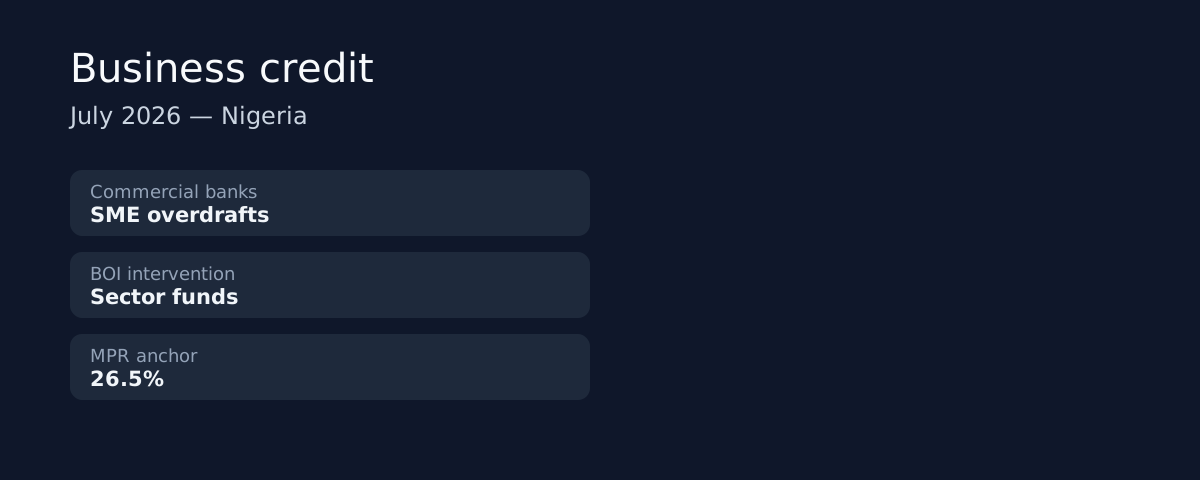
Business credit — July 2026
July snapshot: tier-1 banks push digital SME onboarding (GTBank SME portals, Access Instant Business Loan channels, Zenith corporate desks) while BOI continues to administer FGN MSME intervention and sector funds for manufacturers, agri-processors and youth-led enterprises. Always separate working-capital (stock, payroll bridges) from term/asset finance (equipment, factory fit-out) — mixing them in one application slows underwriting.
| Source | Typical use | Collateral | 2026 note |
|---|---|---|---|
| GTBank SME | Working capital, POS flows | Often cash-flow | Digital pre-qual on turnover |
| Access business | Instant / secured SME | Varies by product | Compare total fees same day |
| BOI funds | Manufacturing, agri, solar | Asset + equity | Intervention pricing below commercial |
| CBN MSME schemes | Targeted sectors | Program-specific | Check active circular on cbn.gov.ng |
Stress-test repayments at +1% above the offered rate — with tight liquidity (CRR 45% for DMBs), spreads can widen between banks even for the same audited statements.
Commercial banks: SME products
GTBank markets SME banking with quick digital loan requests tied to account turnover and sector. Access Bank lists instant and secured business loan paths alongside larger corporate facilities — published marketing often cites SME tickets from ₦1m upward, but real limits follow audited cash flow. Zenith, First Bank (SMEConnect) and UBA run parallel programs combining credit with training or trade services; obtain written term sheets before relying on brochure ranges.
- Working-capital overdraft — revolve for stock and receivables; renews annually.
- Term loan — capex with 12–60 month amortisation and documented collateral.
- Invoice/discounting — for B2B firms with verifiable purchase orders.
- Asset finance — equipment leases with bank title retention until payoff.
BOI and development finance
Bank of Industry (boi.ng) channels sector funds — including FGN MSME intervention windows — toward manufacturing, agro-processing, renewable energy and youth enterprises. BOI facilities typically demand equity contribution, business plan, CAC documents and often off-take agreements; pricing can sit below commercial spreads when matched to an active intervention fund. Pair BOI term money with a commercial overdraft for raw-material bridges rather than funding payroll solely on long-tenor development debt.
What underwriters review
Banks and BOI alike weigh CAC registration, tax clearance, 12–24 months statements, management accounts, and bureau reports (firm and directors). NDIC protects qualifying deposits, not your loan principal — maintain segregated operating accounts and avoid mixing personal spending with SME ledgers. New businesses without history should start with secured lines or BOI youth/MSME programs instead of unsecured instant tickets.
Documentation checklist
Prepare before visiting any lender: CAC status report, TIN, 12-month bank statements, cash-flow forecast, list of existing facilities, and evidence of contracts or purchase orders. Digital lenders may waive paper for micro-tickets but still pull bureau data on directors.
| Bank | Key Eligibility | Minimum Turnover/Revenue |
|---|---|---|
| GTBank | CAC registration, 1-year operation, good credit score | N5M+ annual |
| Access Bank | Registered business, BVN, bank statements (6 months) | N3M+ |
| Zenith Bank | Audited accounts, collateral for larger loans | N10M+ |
| First Bank | SME focus, training completion via SMEConnect | N2M+ |
| UBA | Pan-African ops preferred, 12 months trading | N5M+ |
For instance, if your business is highly digital and values quick processing, GTBank might be the best fit. If you operate across Africa, UBA's Pan-African platform offers significant advantages. Businesses needing substantial funding might look towards Zenith Bank for its higher maximum loan amounts. Understanding these differences allows for a more informed decision.
Approval times also vary significantly. Some banks offer instant options for smaller loans, while larger corporate facilities can take up to a week. Collateral requirements are another key differentiator; some banks are more flexible, while others strictly require asset-based security. It's crucial to assess your business's specific needs against what each bank offers.
Digital platforms are increasingly important for managing business credit. Banks like GTBank and Access Bank have invested heavily in their online and mobile banking services, providing seamless application and management experiences. First Bank's SMEConnect also offers a comprehensive digital hub for its business clients.
Rate environment and negotiation
Anchor negotiations to the 26.5% MPR (CBN May 2026) plus bank margin; development funds may quote lower all-in cost when an intervention window is open. Ask for total cost of credit in naira over the full tenor, including arrangement, monitoring and insurance.
| Tactic | Why it works |
|---|---|
| Three written quotes | Reveals spread dispersion |
| Shorter tenor | Lowers absolute interest paid |
| Collateral | Improves rate and limit |
| Clean bureau | Directors' personal files matter |
Re-check tariffs the same day you sign — digital SME pages update without fanfare.
Navigating the business credit landscape can be complex. Here are some expert tips to help your business secure the best possible credit terms and manage your financial obligations effectively:
- Build credit early: Register your business with the CAC and start building a positive credit history by using trade credit responsibly.
- Compare digitally: Utilize online aggregators and comparison platforms to get real-time rates and compare offerings from multiple banks efficiently.
- Negotiate terms: Don't be afraid to leverage multiple loan offers to negotiate better interest rates or more favorable repayment terms. Consider opting for shorter loan tenures to reduce overall interest paid.
- Monitor CBN policy: Stay informed about the CBN's monetary policy announcements. Changes in the MPR directly impact lending rates, so understanding these trends can help you time your loan applications.
- Avoid over-borrowing: Always ensure your business's cash flow can comfortably cover loan repayments. A good rule of thumb is to ensure your projected cash flow can cover at least 1.5 times your repayment obligations.