

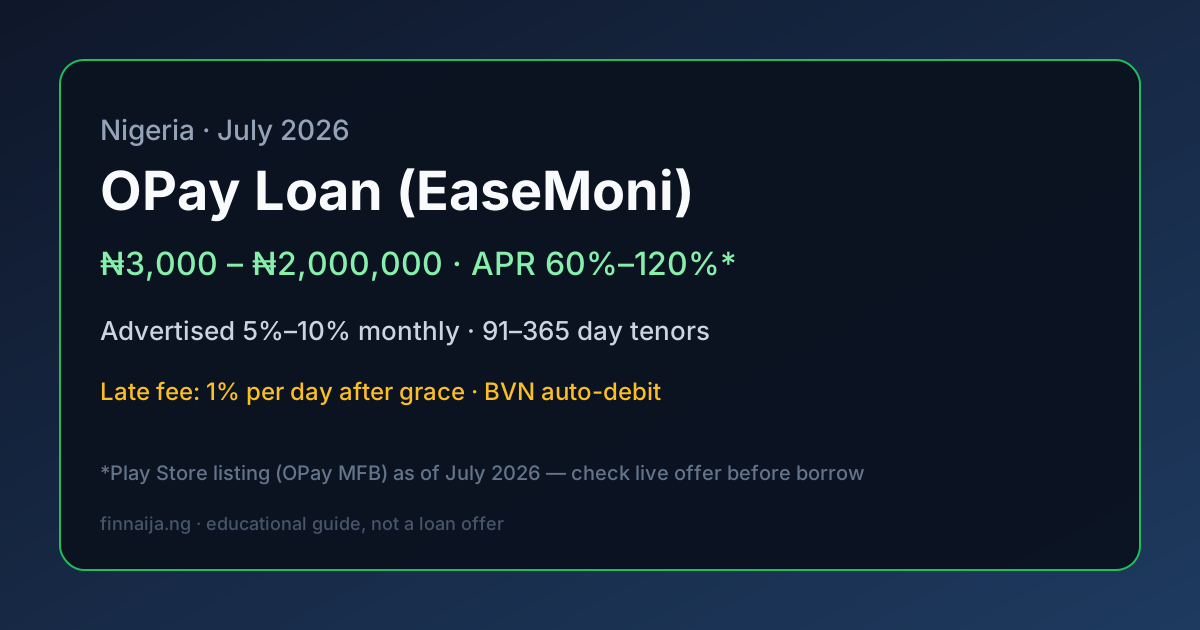
U3-24-NG-20260724OPay loan in Nigeria (July 2026) means short-term digital credit accessed through the OPay ecosystem—most often branded EaseMoni (and the related OKash product). On the Google Play listing under OPay Microfinance Bank Limited, the personal loan band is ₦3,000 to ₦2,000,000, advertised interest 5%–10% per month, and APR 60%–120%, with tenors from 91 to 365 days. That is not free “wallet credit”: you repay principal plus interest, and late balances can attract a 1% per day rollover fee after a short grace window.
Quick answer: download EaseMoni (or open the loan tile inside OPay if offered on your account), complete BVN/NIN KYC, accept only an offer you can repay on the due date, and treat the 1% daily late fee as the real risk—not the marketing “from 5% monthly” line. Always re-check the live quotation in-app; rates are personalised.
What “OPay loan” actually is
OPay itself is a large Nigerian payments and microfinance platform (CBN-licensed microfinance bank; national-status upgrades for several MFBs including OPay were widely reported in early 2026). The loan book users meet as EaseMoni/OKash is a digital micro-lending product: cash disbursed to a bank account or wallet after automated scoring, not a bank branch personal loan with a relationship manager.
Registry and consumer reports often name Blue Ridge Microfinance Bank Limited as the credit engine behind OKash/EaseMoni, while the Play Store developer line and parts of EaseMoni’s own site brand the product under OPay Microfinance Bank Limited. For the borrower, the practical point is: read the loan agreement party name on the screen you accept, and use the contact numbers on that agreement if something goes wrong. Do not assume “OPay support chat” alone can rewrite a Blue Ridge loan contract.
Both EaseMoni and OKash have appeared on FCCPC digital-lending approval lists in recent cycles (including “full approval” style entries for Blue Ridge apps). FCCPC also issued the DEON Consumer Lending Regulations 2025 framework for digital, electronic, online and non-traditional lenders—registration and conduct rules that lenders must keep current. Lists change; verify the live FCCPC digital-lenders page before treating any blog “approved apps” table as law.
Official product numbers (July 2026 Play Store / EaseMoni FAQ)
| Item | Stated figure | Source / caveat |
|---|---|---|
| Loan amount | ₦3,000 – ₦2,000,000 | EaseMoni Play Store (updated ~10 Jul 2026) |
| Tenure band (advertised) | 91 – 365 days | Play Store; first offers may be shorter in practice |
| Monthly interest (advertised) | 5% – 10% | Personalised by credit evaluation |
| APR (advertised) | 60% – 120% | Play Store band; not a quote for every user |
| Worked example | ₦3,000 / 91 days → interest ₦273; total ₦3,273; ~₦1,091 × 3 | Play Store illustration at 5% monthly fee language |
| Late / rollover | 1% per day after grace | EaseMoni FAQ; grace often 1–3 days if granted |
| Age band (typical guides) | 18 – 55 | Product guides; confirm in-app KYC |
| ID stack | BVN + NIN + active bank account | FAQ / terms pattern for digital MFB loans |
| Support phones | 0201 411 1222 / 0700 123 6700 | EaseMoni site & Play listing |
The chart below restates the advertised APR band endpoints from the same Play Store listing—not a personal quote. Your screen offer can sit anywhere in the band, or outside it if the product page changes.
Cost example: small ticket, three instalments
Using the official illustration: principal ₦3,000, 91-day structure, interest fee described as 5% monthly → total interest ₦273, amount due ₦3,273, three equal instalments about ₦1,091. That is a tiny ticket. Scale carefully: if you borrow ₦100,000 on the upper half of the monthly band for several months, total interest can rival a large share of principal before any late fee.
Independent write-ups sometimes recompute effective monthly cost higher than the marketing “5%–10%” line when fees are front-loaded or tenors are short. Treat blog recomputations as signals to read the repayment schedule and total amount due on your own offer screen—not as substitute tariff tables.
Eligibility, scoring and how you apply
Typical eligibility for EaseMoni-style OPay loans: Nigerian resident, roughly 18–55, one BVN per account (terms restrict multi-BVN gaming), NIN for KYC, and a working bank account or card for disbursement and auto-debit. Application is fully digital: fill prompts, wait for a real-time decision, accept or decline the quotation.
Scoring, per EaseMoni’s FAQ, blends phone/handset signals, financial SMS patterns, stated purpose, and prior repayment history. That is why a thin first offer is normal: the model has little history on you. Limit growth is behavioural—clean repayments and deeper usage tend to open larger tickets; defaults and late fees do the opposite and can also hit your credit bureau file.
Two access paths exist in market: the standalone EaseMoni app (and OKash app) and loan tiles nested inside the wider OPay super-app for eligible wallets. The contract still names a licensed MFB party. OPay’s savings/OWealth features are separate products; do not confuse “daily interest on balance” marketing with loan APR.
Repayment, grace days and default powers
Repay via in-app Repay, or expect auto-debit from the linked card/account on due date. FAQ language: late balances attract 1% rollover interest per day. A 1–3 day grace may apply; if you miss the whole grace window, fees can be calculated for the entire delay including grace days. Multi-instalment loans: missing the first instalment can remove grace on later ones.
Default tools commonly include repeated debit attempts, tracking when money appears, and under mandate language the ability to debit accounts linked to your BVN (GSI-style recovery across banks is a known Nigerian industry pattern). Terms also allow contact of emergency numbers if you go silent—so list only people who know you borrowed. Defaults feed credit bureaux and shrink future limits across formal lenders, not only OPay.
Consumer media has repeatedly criticised 1% per day late charges as economically harsh versus CBN-era expectations that late charges sit nearer a fixed monthly percentage on unpaid balances. Whether any specific charge breaches a circular is a regulatory/compliance question—the practical borrower rule is simpler: never plan to roll a digital micro-loan day after day.
How EaseMoni stacks against other NG digital lenders
Advertised bands move; the table below is orientation from product pages and 2026 comparison write-ups, not a ranking product. Confirm each app’s live screen.
| Product | Typical max (guides) | Advertised monthly band | Notes for borrowers |
|---|---|---|---|
| EaseMoni (OPay ecosystem) | Up to ₦2,000,000 (Play) | 5%–10% (APR 60%–120%) | Fast cash; harsh daily late fee |
| OKash (related brand) | Similar micro-loan stack | Often quoted ~3%–15% monthly in guides | Same FCCPC/Blue Ridge conversation |
| FairMoney | Guides cite up to ~₦3m personal | Wide personalised band in reviews | Licensed MFB; also savings products |
| Carbon | Guides often ~₦1m | Mid–high personalised monthly % | Banking + loan bundle |
| PalmPay Flexi-style loans | Often lower ceilings in guides | Lower monthly % quotes in some reviews | Shorter tenors common |
If you need a longer amortising schedule with a clear reducing-balance table, compare against a bank or MFB amortized loan structure rather than stacking 30-day app loans. For broader pricing context see best personal loan rates in Nigeria. Mobile-network style products such as Airtel loan sit in a different channel with their own fee tables.
Risks worth pricing before you tap Accept
- Daily late arithmetic: 1% per day is not “small.” Ten days late on ₦50,000 is ₦5,000 in rollover alone before principal interest.
- Auto-debit & BVN reach: Keep repayment money on the linked account early; surprise debits on salary day are a feature of the mandate, not a bug.
- Data & contacts: Scoring may use device and SMS signals; emergency contacts can be reached if you vanish—set expectations with them.
- Fake apps: Install only from official store listings under OPay MFB / known EaseMoni package names; never repay to a personal account someone DMs you.
- Over-stacking: Multiple apps at once destroy cash-flow buffers and bureau scores. One manageable facility beats three “tiny” facilities.
Business cash needs differ from salary-smoothing micro-loans—see business credit options and formal working-capital products if the ticket is inventory or equipment, not a weekend gap.
When an OPay/EaseMoni loan is (and is not) rational
More rational: a known cash inflow before due date (confirmed salary, invoice, remittance), amount small relative to that inflow, and you already compared total amount due against alternatives. Less rational: rolling living costs month after month, gambling on limit increases, or borrowing to repay another app’s late fee—the 1% daily meter turns that into a trap quickly.
Regulatory context (CBN microfinance rules, FCCPC DEON 2025, NDIC coverage on true deposit balances at licensed MFBs) improves the baseline versus unregistered apps—but licensed does not mean cheap. Cheap is the total you repay if you stay on schedule.
Checklist before you borrow
- Confirm the legal name on the offer (OPay MFB, Blue Ridge, or both in partner language).
- Screenshot the amount, due date(s), interest, total payable, and late-fee clause.
- Verify support numbers match easemoni.com / Play listing (0201 411 1222, 0700 123 6700 as of mid-2026 listings).
- Set a calendar alert two days before due date; fund the debit account early.
- If refused, fix bureau issues first rather than spraying applications—see how credit bureaux report digital loans.
This page is educational market research for finnaija.ng readers, not a loan solicitation, credit decision, or partnership with OPay, Blue Ridge, EaseMoni or OKash. Figures are dated to sources checked around July 2026 and can change without notice on the apps themselves.